Performative Exhibition
National Gallery of Arts, Tirana
September – October 2008
Curated by Sonja Lau and André Siegers
Curatorial Statement and Context
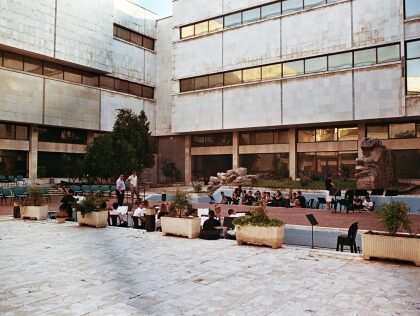
In 2008, the National Gallery – or so it was proclaimed – underwent its first substantial refurbishment since its inauguration by dictator Enver Hoxha in 1974. Clearly, this had not only technical reasons.
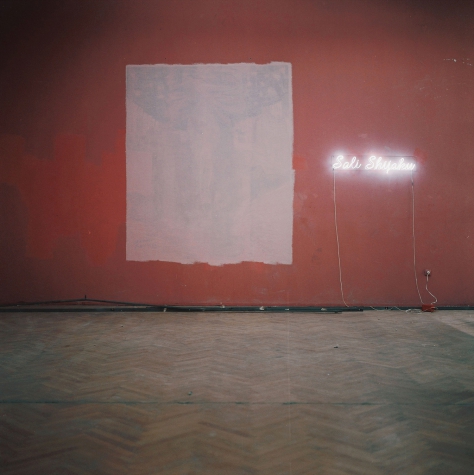
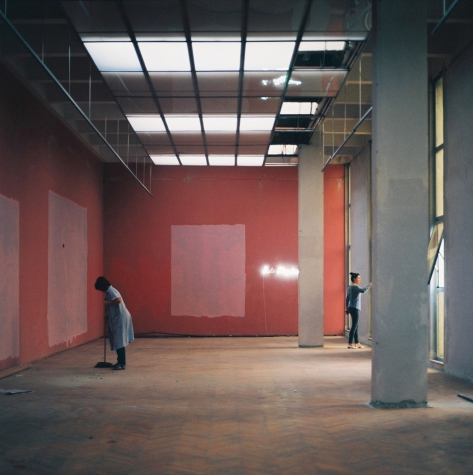
Amongst many refurbishment tasks, one significant alteration of the gallery was the whitening of the red walls, which until then had hosted the Socialist Realism collection. This investment was part of a general strategy of “modernization”, but the shift from red to white also spoke of something else. It proposed a move towards the historicizing of a collection, that seemingly wasn’t deemed distant enough. Whereas the red walls recalled a sort of “in situ” of the Socialist Realism collection, a somewhat haunting presence, the whitening of the walls came with the comfortable effect of stepping into a safe distance. The paintings of the Socialist collection would leave the building asone thing, and they would return to the site as something else. Some would, as we later learned, not return at all. To dedicate an exhibition to this transformation (and the pars pro toto this suggested for the society as a whole) became the crucial concern of the project “Re-Paintings”. It considered the “whitening” as a pragmatic part of renovation, but above all as a rendering of one art (hi)story into another one.
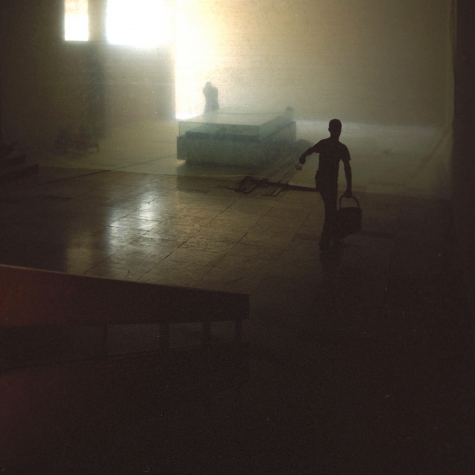
There were also several other concerns that lead to the project we developed from there. One being the very special circumstance, that when renovating a space, and when whitening walls, every artwork has to at least temporarily leave to building. We were very interested in the advent of a gallery devoid works, of the vacancy of the building. It suggested a moment in time when the ‘old’ institution had already left whilst the ‘new’ institution was still on await – providing a site in between, and therefore “off” powers. To “work together” with an institution that was literally absent, became an important undercurrent to the project.
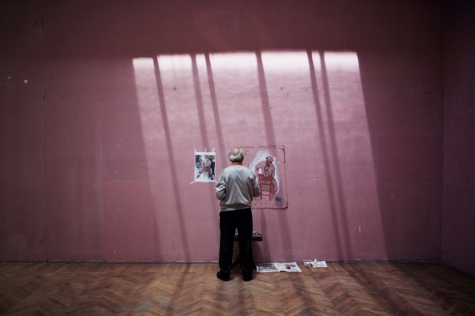
Another preliminary thought was the ‘oddity’ of the color red itself. As we learned, the reddening of the National Gallery had been in fact applied during post-socialist times, in the context of Gëzim Qëndro’s astonishing but little known exhibition “Homo Socialisticus” (1997). It was an aesthetic, ‘fake’ red that was utilized to stimulate both fear, nostalgia, irony and critique. It was also in the “Homo Socialisticus” context that the Socialist Realism collection resurfaced – on red – for the first time since 1991. Qëndro had advised the gallery team to never clean the space again. The entire installation of “Homo Socialisticus” was devised to disappear under dust and oblivion: a “curatorial vision” that soon turned into a new “reality”. When visiting the gallery in 2008, facing the worn out, dusty red walls, we noted a slight memory of Qëndro’s project amongst the younger artists, but most visitors considered the red gallery as an ‘original’ element from Communist times. What had started as a curatorial critique, had turned once again into a site of discomfort and prolonged past. We were thus in a working context that was both fake and real, dead and alive, ordinary and highly cryptical. There was nothing but the coats, the walls and skins of the institution to address. This was how the project “Re-Paintings. An Exhibition on Coats” came into being.
“Re-Paintings”. The Project
In line with the considerations mentioned above, the project “Re-Paintings” took place deliberately during the heydays of the gallery’s renovation phase. It began once all artworks had left the gallery spaces, and it put a temporary pause, or freeze, on the renovation works themselves.
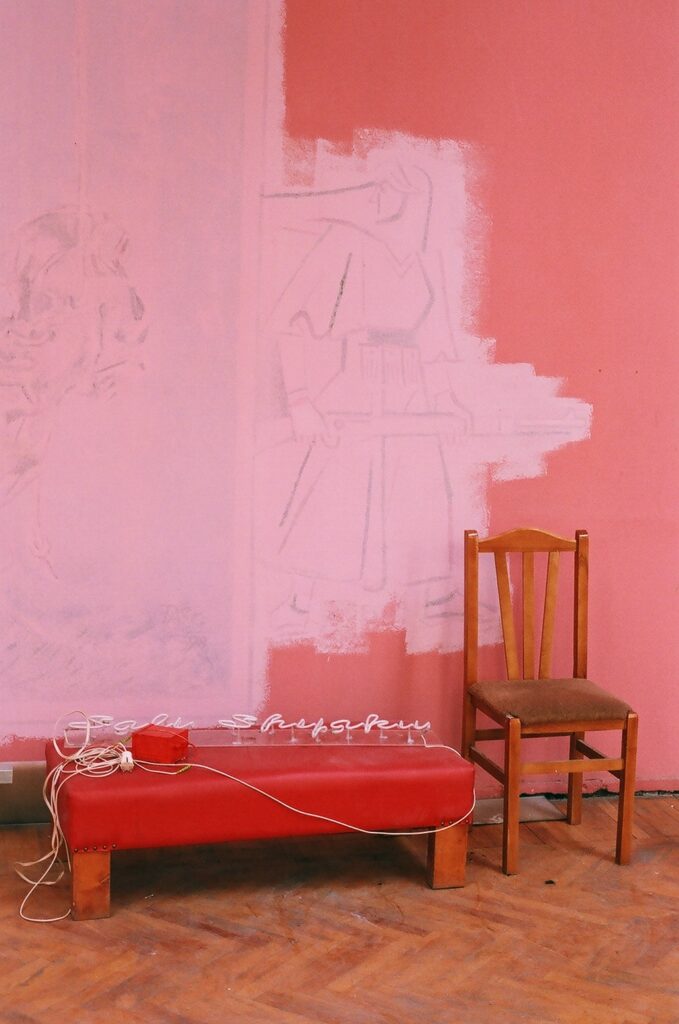
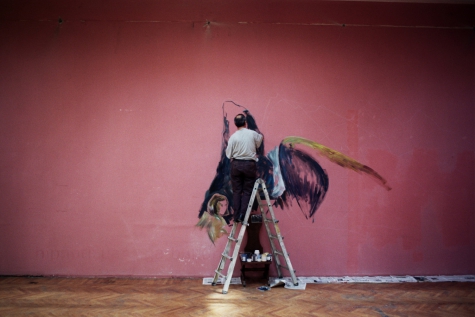
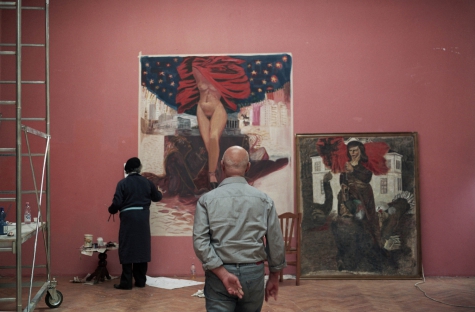
Within this context, we invited a number of painters, in most cases former official “people’s painters” back into the empty gallery space. We were looking for artists whose works had been part of the Socialist collection, those who had thus seen their works leaving the space. The general task was to choose one of the paintings from the past, and to dare a current, “free” interpretation of the work in response to the temporary “free” exhibition space: in short, to dare a “Re-Painting”. A “Re-Painting” could be identical to the previous painting, it could be utterly different, or it could be anything in between. Most important, those “Re-Paintings” were to be applied directly onto the gallery’s red walls, they were temporary paintings that would disappear once the renovation works continued. They were not safe in regard to the future, they were farewell works. But they were also utterly safe from another perspective, layered permanently – and up until today – under the new white coat of the institution, inside the metabolic system of the National Gallery, as part of its “institutional memory”. If the ongoing battle (or, complicity) between art and power often eradicates memory functions and specific positions, if transitions and transformations often go clandestine and without a clear visual expression, then “Re-Paintings” suggested to invent, stage, perform what would otherwise go missing.
During the entire time of the production, that is the painters’ work inside the gallery, the space remained open to the public. In this sense, the “exhibition” worked similar to an artist studio, a temporary squatting situation. It operated literally in reverse: starting with the first brush, then “opening” on the final day, that would equally announce the continuation of the renovation works, thus the approaching whitening and disappearance of the works.
However more than an artist studio situation, “Re-Paintings” was a stage situation, a project that believed in theatricality and theatrical means in order to render a complex situation tangible. In this sense, terms like “free” or “U-topos” are not to be confounded with curatorial naivety, but must be understood as a “stage directive”, something to react to, both as subject and as an actor performing one’s own subjectivity. This theatricality concerned the artists, the spectators, the (absent) institution and us as curators alike. If there was a title for this collective performance other than “Re-Paintings”, it could be best coined as a “Staged Messianism in the name of the White Cube”.
The conversations and artistic ideas, but also the political, personal and ideological tensions that occurred during the weeks of production, are what keeps the project relevant up to today. Aside from photography, they are not recorded or archived by other means, but have found the irreversible space of dwelling under the white walls of the National Gallery. Perhaps, they help to recall, from time to time, that “White” is not an innocent color.
Artists: Xsenofon Dilo, Agim Kadillari, Xheneta Kadillari, Skënder Kamberi, Sali Shijaku, ‘Taso’. With an artistic contribution by Heldi Pema.
Supported by FAVA.